Patek Philippe Ref. 5370P Decoded Through the Art of Split-Seconds Timing
Serving as a living manifesto, the Ref. 5370 captures the brand’s pursuit of perfection—balancing engineering rigor with timeless allure.
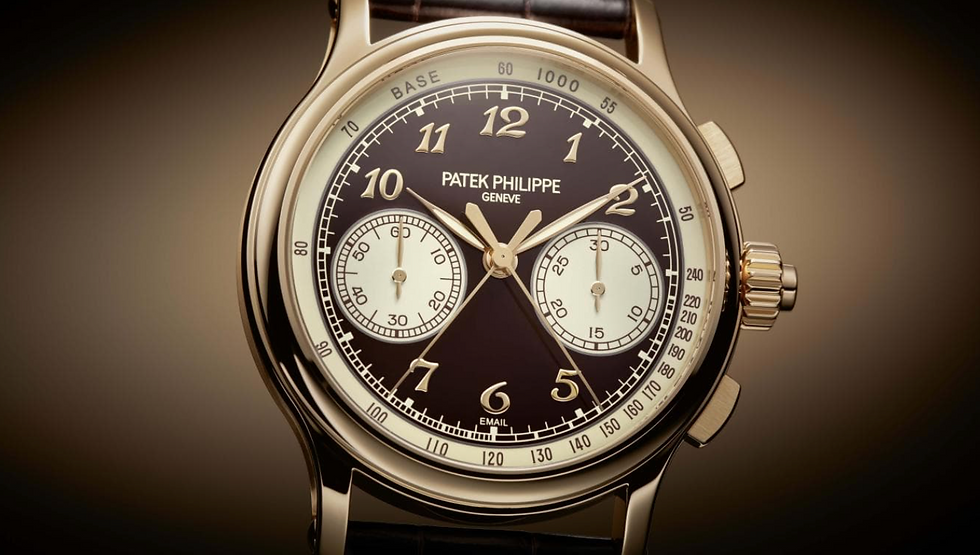
Upon its introduction of the Ref. 5370P — denoting platinum — in 2015, followed by the Ref. 5370R in rose gold, Patek Philippe distinctly defined the timepiece as the manufacture's modern, unadulterated split-seconds chronograph, devoid of calendar, repeater, or any superfluous features. The 5370 emphasises proportion and clarity on the wrist. The 41-millimeter case is sufficiently thick to house the movement and is water-resistant, designed for comfort with sculpted lugs and a concave bezel that encircles the dial. The dial, initially in black grand feu enamel and subsequently in deep blue and brown for the 5370R, exemplifies restraint: featuring applied Breguet numerals, feuille hands, dual recessed registers, and a tachymeter scale that closely follows the perimeter without compromising visibility.
The true narrative, however, resides beneath the sapphire caseback. Reference 5370 contains the calibre CHR 29-535 PS, a split-seconds variant of the base CH 29-535 PS. The six foundational patents (see to the cover story) are complemented by a supplementary array of enhancements for the rattrapante function, derived from Patek Philippe’s expertise with the 5004 and codified in the advancement of the 5204. The wearer experiences a chronograph with an exceptionally smooth split-seconds functioning. Commencement, cessation, division, reconnection, and reinitialization transpire without discernible stutter or tremor, and devoid of the slight diminution in balance amplitude that astute observers occasionally detect in prior rattrapantes. The drive train, tooth profiles, and isolator collaborate to guarantee that the chronograph functions as a single-hand system until a split is desired.
The 5370 serves as an open textbook on Patek Philippe’s split-seconds philosophy. It illustrates the manufacturer's essential components in a rattrapante: dual column wheels, a horizontal clutch for a traditional sensation, a meticulously designed isolator, optimised tooth geometry, and a degree of hand-finished steelwork that elevates clamps and levers to decorative objects in their own right. It serves as the emotional foundation of the modern split-second narrative. While the 5204 and 5308 incorporate the rattrapante into broader mechanical frameworks, the 5370 highlights it prominently.


Comments